
IELTS GT READING 2026: Types of Employee Training Reading Answers has a total of 7 questions in total. In the question set given, you have to state which of the passages contain the information given in the text. Types of Employee Training reading Answers is one of IELTS GT reading practice passages.
Using IELTS Reading Practice Questions, you can increase your vocabulary, sharpen your critical reading skills, and become more familiar with the various question types in reading tasks. Furthermore, practice enhances vocabulary and improves analytical reading skills, both of which are necessary for success for scoring higher bands in IELTS GT reading 2026 tests
Table of Contents
Topc for IELTS GT reading 2026
Types of Employee Training reading | IELTS GT reading 2026 Answers
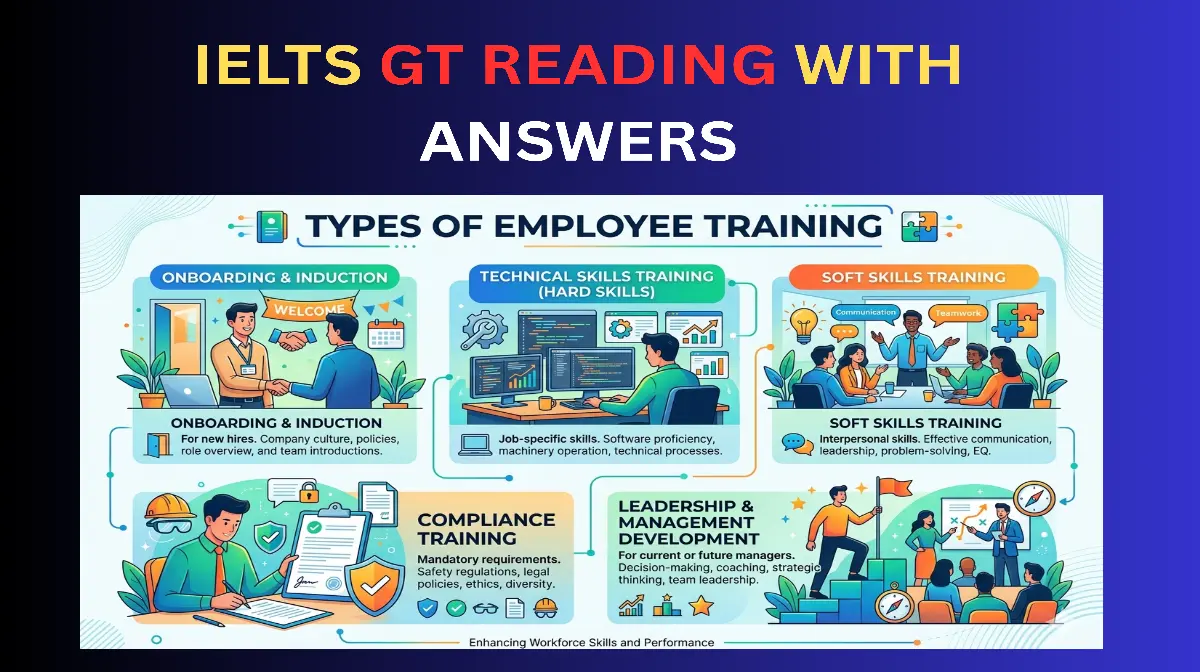
There are a number of different types of training we can use to engage an employee. The training utilised depends on the amount of resources available for training, the type of company, and the priority the company places on training.
A. Technology Training: Depending on the nature of the work, technical training will be required. Technical training is a type of training meant to teach the new employee the technological aspects of the job. In a retail environment, technical training might include teaching someone how to use the computer system to ring up customers. In a sales position, it might include showing someone how to use the customer relationship management (CRM) system to find new prospects. In a consulting business, technical training might be used so the consultant knows how to use the system to input the number of hours that should be charged to a client.
B. Quality Training: In a production-focused business, quality training is extremely important. Quality training refers to familiarising employees with the means of preventing, detecting, and eliminating non-quality items, usually in an organisation that produces a product. In a world where quality can set your business apart from competitors, this type of training provides employees with the knowledge to recognise praoducts that are not up to quality standards and teaches them what to do in this scenario.
C. Skills Training: Skills training includes proficiencies needed to actually perform the job. Most of the time, if the skills training is given in-house, it can include the use of a mentor.
D. Soft Skills Training: The fourth type of training is called soft skills training. Soft skills refer to personality traits, social graces, communication, and personal habits that are used to characterise relationships with other people. Many difficulties within organisations are due to a lack of soft skills, or interpersonal skills, not by problems with the business itself. As a result, Human Resources and managers should work together to strengthen these employee skills. Soft skills training can be administered either in-house or externally.
E. Professional Training: In some jobs, professional training must be done on an ongoing basis. Professional training is a type of training required to be up to date in one’s own professional field.
F. Team Training: The goal of team training is to develop cohesiveness among team members, allowing them to get to know each other and facilitate relationship building. We can define team training as a process that empowers teams to improve decision-making, problem solving, and team-development skills. It can often occur after an organisation has been restructured and new people are working together, or perhaps after a merger or acquisition.
G. Safety Training: Safety training is a type of training that ensures employees are protected from injuries caused by work-related accidents. Safety training is very important for organisations that use chemicals or other types of hazardous materials. Safety training also includes evacuation plans, fire drills, and workplace violence procedures.
H. Managerial Training: After someone has spent time with an organisation, they might be identified as a candidate for promotion. When this occurs, managerial training might be required. Topics might include those from the soft skills section, such as how to motivate and delegate, while others may be technical in nature. The goal of this training program is to increase productivity, one of most organisations’ core values.
Questions 1-7
Which section of information mentions the following information? Write the correct letter, A-H.
NB You may use any letter more than once.
- If this type of training is done inside the company, the assignment of an internal tutor can help the process.
- This type of training can increase a company’s output and efficiency.
- This type of training needs to be a continuous process.
- This type of training often depends on the type of job the employee has.
- This type of training is common after a company has been reorganised.
- Employees without this type of training can often cause problems within companies.
- This type of training allows employees to measure products against pre-set standards.
IELTS GT READING 2026 PRACTICE SAMPLES
JOIN US FOR COMPLETE 1 HOUR MOCK TEST
ANSWERS
- C
- H
- E
- A
- F
- D
- B